
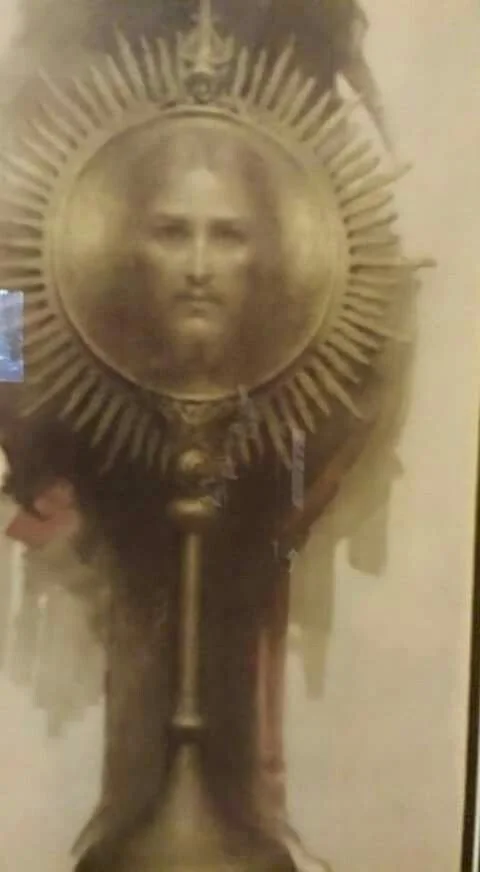
Reverence for the Holy Eucharist.
At the very heart of the Catholic faith is the Holy Eucharist. It is not a symbol or a representation, but truly and substantially Our Lord Jesus Christ: His Body, His Blood, His Soul, and His Divinity. Every Host, even the smallest fragment, contains the whole Christ. Because of this, the Church has always called the faithful to approach the Holy Eucharist with the deepest reverence, humility, and awe.
What Reverence Truly Means
Reverence is not a human invention. It is revealed by God Himself. In Sacred Scripture, reverence means recognising the holiness of God and responding with awe, humility, obedience, and a holy fear of offending Him.
The Bible shows clearly that what is consecrated to God must never be treated as ordinary.
One of the most striking examples is found in the Old Testament with the Ark of the Covenant, the sacred dwelling place of God’s presence among His people.
When the Ark was being transported, an incident occurred:
“And when they came to the threshing floor of Nacon, Uzzah put forth his hand to the ark of God and took hold of it, for the oxen shook it. And the anger of the Lord was kindled against Uzzah, and God struck him there for his error; and there he died beside the ark of God.”
(2 Samuel 6:6-7)
Uzzah’s action may have appeared well-intentioned. He reached out to steady the Ark. Yet God had already given clear instructions regarding what was consecrated:
“They shall not touch any holy thing, lest they die.”
(Numbers 4:15)
This reveals something essential:
Holiness is not defined by intention alone.
What is consecrated to God must be approached according to His order.
God’s presence is not to be treated casually.
The Ark of the Covenant was a shadow of something far greater.
The Ark contained the tablets of the Law, the manna from heaven, and the rod of Aaron, which were signs of God’s covenant.
But the Holy Eucharist is not a sign.
It is Jesus Christ Himself.
If such reverence was required for the Ark, which held sacred signs, how much more for the Eucharist, which is God truly present?
This account is not simply an isolated moment. It reveals a lasting principle.
God teaches His people how what is holy is to be approached.
This principle does not disappear with the coming of Christ. It deepens.
Within the life of the Church, this reverence is expressed through sacred order.
Consecrated Hands and Sacred Order
Within the life of the Church, not all hands are set apart in the same way. There is a sacred distinction regarding who is entrusted with the handling of the Holy Eucharist.
The ordinary ministers of Holy Communion are bishops, priests, and deacons. Among them, bishops and priests receive a unique sacramental consecration of their hands at ordination. Their hands are anointed and set apart specifically for the offering of the Holy Sacrifice of the Mass and for handling the Body of Christ.
This consecration is not merely symbolic. It expresses a deeper theological reality that the Eucharist is not ordinary and must be treated according to its sacred nature.
For this reason, throughout much of the Church’s history, the handling of the Eucharist has been closely associated with consecrated hands. This practice developed as a visible expression of reverence.
In certain circumstances, the Church permits lay people to assist in the distribution of Holy Communion as Extraordinary Ministers. This is a provision made for necessity. It does not change the reality of what the Eucharist is, nor does it remove the distinction between what is ordinary and what is permitted.
The lesson of Uzzah remains relevant here, not as a direct equivalence, but as a warning against casualness.
Good intentions alone are not enough when approaching what is holy.
Reverence must be formed according to God’s will, not human convenience.
The more sacred the reality, the greater the care required.
Reverence in the Presence of God
Throughout Scripture, reverence is shown in very real and visible ways.
It includes a holy fear of the Lord:
“Serve the Lord with fear, and rejoice with trembling.” (Psalms 2:11)
It includes bodily humility:
“O come, let us worship and bow down; let us kneel before the Lord our Maker.” (Psalms 95:6)
It includes recognising holy ground:
“Take off your sandals from your feet, for the place on which you are standing is holy ground.” (Exodus 3:5)
Reverence is therefore not merely external behaviour. It is the right response of the soul to the reality of God.
A New Testament Warning
This same seriousness continues in the New Testament.
Saint Paul gives a direct warning regarding the Eucharist:
“Whoever, therefore, eats the bread or drinks the cup of the Lord in an unworthy manner will be guilty of profaning the body and blood of the Lord.”
(1 Corinthians 11:27)
This confirms that the Eucharist must never be approached casually or treated as ordinary food. To do so is not simply a mistake. It is a profanation of the Body and Blood of Christ.
How the Earliest Christians Received the Holy Eucharist
From the earliest centuries, Christians approached the Eucharist with profound awareness of the sacred. The Church Fathers speak of great care being taken to ensure that no fragment of the Sacred Host was lost. While external practices varied across regions and periods, the constant reality remained: the Eucharist was treated as holy beyond all comparison.
As the Church’s understanding and liturgical expression developed over time, practices became more visibly protective of this mystery. Reception on the tongue and the use of consecrated hands became the universal norm in the Latin Church for many centuries. This was not a rejection of earlier times. It was a deepening of reverence and a clearer expression of what the Church has always believed: we are receiving God Himself.
The Use of Lay Ministers
In more recent times, the use of Extraordinary Ministers of Holy Communion has become widespread. The Church permits their use in specific circumstances, particularly when there is genuine necessity, such as large congregations or the absence of sufficient clergy.
However, in many places, what is meant to be extraordinary has become ordinary. When this occurs, the visible distinction surrounding the Eucharist can become blurred, and a more casual approach can develop.
The concern is not directed at individuals, but at restoring clarity. The Eucharist is not ordinary bread, and its distribution is not an ordinary act.
Lex Orandi, Lex Credendi
The Church has long expressed a profound truth in the phrase:
Lex orandi, lex credendi
“The law of prayer is the law of belief.”
This means that how we worship shapes what we believe.
If the Holy Eucharist is treated casually, belief in the Real Presence can gradually weaken. If it is approached with reverence, silence, and adoration, faith is strengthened and preserved.
The way we receive Holy Communion is therefore not insignificant. It is a reflection of what we believe about who is truly present before us.
Receiving the Holy Eucharist with Reverence
Because Jesus Christ is fully present in the Eucharist, even in the smallest fragment, the manner in which we receive Him matters deeply.
Receiving Holy Communion kneeling and on the tongue expresses humility, adoration, and trust. It makes visible what is invisible:
That we receive, rather than take, the gift of God.
That we approach Our Lord in humility.
That we recognise His Real Presence.
That we seek to protect even the smallest fragment of the Sacred Host.
When receiving on the tongue, the risk of particles being lost is reduced. This is not merely a matter of preference. It is about safeguarding the Eucharistic Presence.
To kneel is to adore. Throughout Scripture, kneeling is the posture of those who recognise the presence of God. In the Holy Eucharist, we are not before a symbol. We are before Him.
The Importance of Kneelers
Kneelers serve both a practical and spiritual purpose. They assist the faithful, especially the elderly, the weak, or those with physical limitations, in receiving Holy Communion in a stable and reverent posture.
Their presence communicates that kneeling is welcomed and supported. Without them, many may feel unable or discouraged from receiving in this way.
Providing kneelers is a simple yet meaningful step toward restoring reverence within the Church.
Reverence in Every Mass
The call to reverence before the Holy Eucharist is not limited to one particular form of the Mass, but belongs to every Catholic heart before Jesus Christ truly present in the Blessed Sacrament. Whether at the Traditional Latin Mass or the Novus Ordo Mass, the faithful are called to remember before whom they stand.
While many Novus Ordo Masses are celebrated with deep reverence and fidelity, in many places sacred silence, recollection, and outward reverence have gradually diminished. Yet the Church continually calls the faithful back to deeper awareness of the holiness and majesty of God truly present among us.
“Be still, and know that I am God.” — Psalm 46:10
“The Lord is in His holy temple; let all the earth keep silence before Him.” — Habakkuk 2:20
“At the name of Jesus every knee should bow.” — Philippians 2:10
At every Mass, Heaven touches earth. The Holy Sacrifice of Calvary is made present upon the altar, and Jesus Christ becomes truly present within the Holy Eucharist. Because of this, sacred silence, kneeling, genuflection, prayerful recollection, and reverent devotion are not empty externals, but visible expressions of faith in the living God before us.
The Church has long understood this truth through the principle of lex orandi, lex credendi — “the law of prayer is the law of belief.” The way we worship shapes what we believe, and what we believe shapes the way we worship.
When reverence is strengthened, faith in the Real Presence is strengthened also. Through silence, humility, Eucharistic adoration, and loving devotion before Our Lord, souls are drawn away from worldly distraction and lifted toward deeper awareness of Jesus Christ truly present within His Church.
Sacred Silence and Sacred Music
Throughout the history of the Church, sacred music and sacred silence have helped lift the soul toward God and draw the heart into prayer, recollection, and contemplation before the sacred mysteries.
The purpose of music within the Mass is not entertainment or performance, but worship. Sacred music should assist the faithful in turning their hearts toward Jesus Christ, fostering reverence, prayer, and awareness of the holiness of the Holy Eucharist.
Sacred silence is equally important. Moments of silence before Mass, during the liturgy, and especially after receiving Holy Communion allow the soul to recollect itself before the living God truly present within us.
In an increasingly noisy and distracted world, silence within sacred spaces becomes a profound witness to the Presence of God. The Church continually calls the faithful not to conform themselves to the spirit of the world, but to be transformed in Christ. Reverence within the liturgy should therefore help lift the soul beyond worldly distraction and toward the beauty, holiness, and transcendence of God.
We are all called to holiness and sainthood in Jesus Christ. Sacred silence, reverent worship, and music ordered toward prayer help lift the soul toward Heaven, drawing hearts away from worldly distraction and forming within us deeper recollection, reverence, and likeness to Christ.
When sacred music, prayerful silence, reverence, and recollection are preserved within the Mass, the heart is more easily drawn into deeper awareness of Jesus Christ truly present within the Holy Eucharist.
A Call to Restore Reverence
Reverence for the Holy Eucharist is not about rigid externalism. It is about love, love for Jesus Christ truly present among us.
To receive Him with care, to protect even the smallest fragment, and to approach Him on our knees in humility are acts of faith.
In a world that has grown increasingly casual toward the sacred, we are called to respond with reverence.
Through small but intentional acts, we help restore what must never be forgotten:
That the Holy Eucharist is not a thing.
It is not a symbol.
It is a Person.
He is truly here.
It is Jesus Christ, Body, Blood, Soul, and Divinity.
It is God.