
Holy Face Devotion
A Heaven-revealed Remedy to the Ills of our Times.
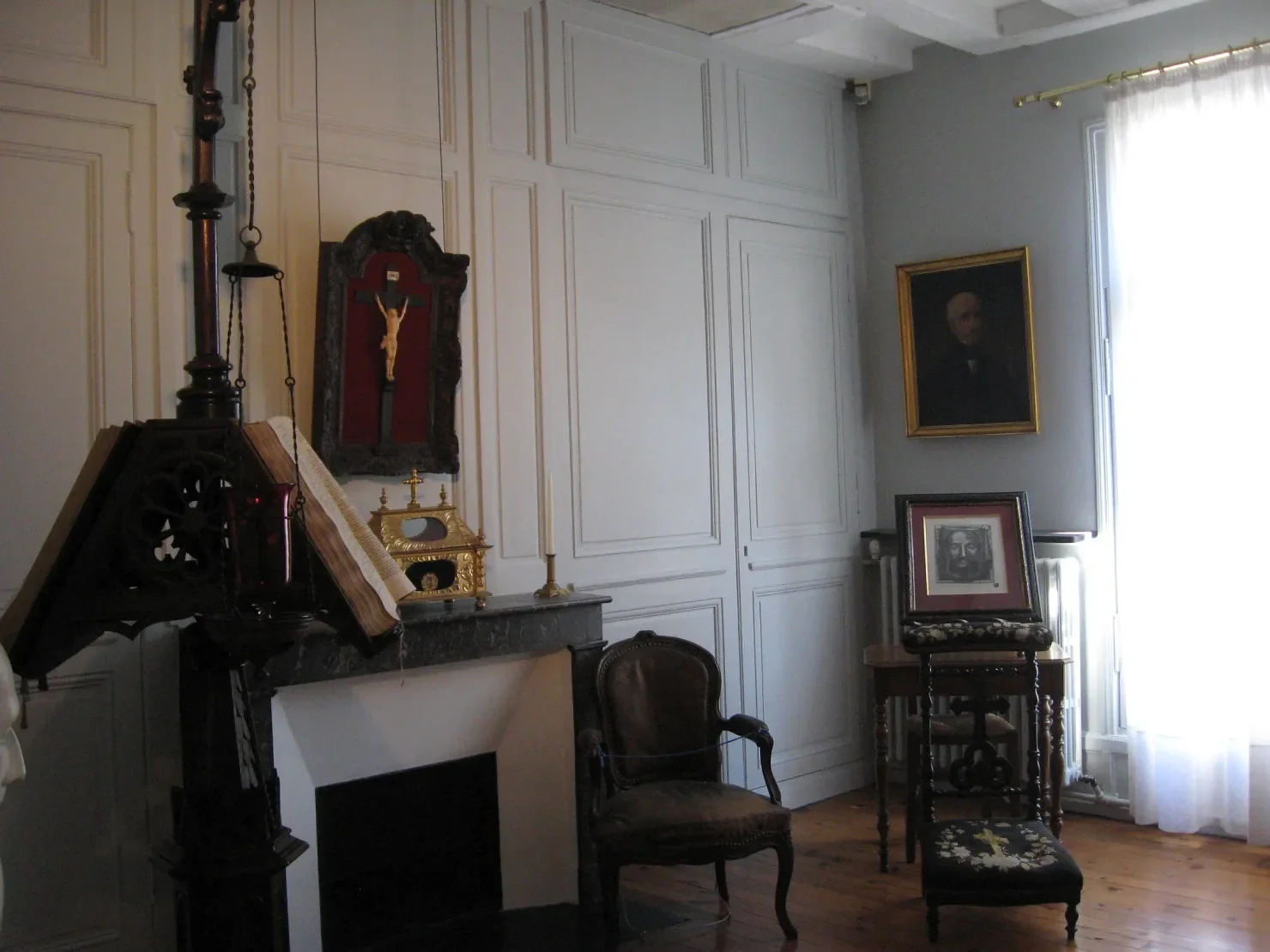
(Background Photo: Leo DuPont’s Bedroom.)
The Holy Face Devotion: Meaning and Spiritual Purpose
The devotion to the Holy Face of Jesus centres on contemplating Christ in His suffering, especially during His Passion. It draws attention to His wounded and humiliated Face—the Face that was struck, spat upon, and crowned with thorns—revealing both the depth of His love and the cost of redemption.
This devotion is closely linked to the moment traditionally associated with the Veil of Veronica, when the Face of Christ was imprinted as He carried the Cross. From the earliest centuries, Christians have reflected on this mystery, recognising the Holy Face as a silent witness to His humility, suffering, and mercy.
To fix one’s attention on the Face of Christ is not only an act of devotion, but an encounter that calls the soul to change. In Scripture, Saint Peter’s repentance begins not with the rooster’s crow, but with the moment Christ turns and looks at him. That gaze reveals truth, awakens sorrow for sin, and leads to conversion.
This same spiritual reality is expressed in words attributed to Blessed Maria Pierina:
“Whenever My Face is contemplated, I will pour My love into the hearts of those who do so, and through My Holy Face many souls will be saved.”
Foundations in Early Christianity
From the beginning of the Church, the Face of Christ has held a place of deep reverence. Those present at His birth—Mary, Joseph, the shepherds, and the Magi—were the first to behold Him. Over time, this act of gazing became a form of prayer rooted in love and adoration.
Two significant relics became central to this devotion:
The Veil of Veronica, connected to Christ’s journey to Calvary
The Shroud of Turin, bearing the imprint of His crucified body
These images helped shape how the faithful meditated on Christ’s suffering.
Renewal in Tours: Sister Mary of St Peter
A decisive moment in the history of the devotion took place in 19th-century France. In Tours, a Carmelite nun, Venerable Sister Mary of St Peter, received a series of revelations over several years.
She was entrusted with a mission of reparation, particularly for blasphemy, the profanation of Sundays, and offenses against the Holy Name of God. From this came the Golden Arrow prayer, offered as a response to these sins.
She died on 8 July 1848, known for her sanctity, but her mission continued beyond her lifetime.
The Miracle of Veronica’s Veil (1849)
Soon after, during a time of political upheaval, Pope Pius IX was forced into exile. In response to the crisis affecting the Church, he called for prayer and arranged for the Veil of Veronica to be publicly displayed in St Peter’s Basilica.
On 6 January 1849, an extraordinary event was witnessed. For approximately three hours, from noon until 3pm, the image on the veil became distinctly visible and appeared almost lifelike. Observers reported signs resembling tears and blood.
The basilica bells were rung, crowds gathered, and the event was formally recorded by an apostolic notary. As photography did not yet exist, artists preserved the event through drawings.
The Shroud of Turin (1898)
Nearly fifty years later, the development of photography brought new attention to the Holy Face. In 1898, Secondo Pia photographed the Shroud of Turin and discovered the detailed image present on it—something not clearly visible before.
This discovery renewed interest in contemplating the Face of Christ.
Venerable Leo DuPont
At the same time, Venerable Leo DuPont, a layman in Tours and a friend of Sister Mary of St Peter, became a central figure in spreading the devotion.
He kept an image of the Holy Face in his home, with a lamp burning before it, and gathered others to pray. Over time, reports of healing emerged, often associated with the oil from the lamp used in prayer.
These occurrences continued for many years and even after his death. His home was eventually transformed into the Oratory of the Holy Face, where both he and Sister Mary of St Peter are buried.
The Archconfraternity and the Universal Church
In 1885, Pope Leo XIII formally approved the devotion and established the Archconfraternity of the Holy Face for the entire Church.
Among those enrolled were the family of Saint Thérèse of Lisieux, the Martins. This devotion profoundly influenced their interior life. St Thérèse made this love visible even in her religious name, taking the title “of the Child Jesus and of the Holy Face.” Her sister Céline later created a widely recognised image of the Holy Face, and their parents were eventually canonised together as saints.
Blessed Maria Pierina and the Holy Face Medal
In the early 20th century, the devotion was renewed again through Blessed Maria Pierina, who reported visions encouraging the spread of devotion to the Holy Face as an act of reparation.
She also described a profound experience while kissing a crucifix, sensing what she believed to be the living presence of Christ.
Through her, the Holy Face Medal was introduced. One side bears the image associated with the Shroud of Turin and the words:
Illumina, Domine, vultum tuum super nos
(“May the light of Your Face shine upon us,” Psalm 66:2)
The reverse side shows a radiant Eucharistic Host, the monogram “IHS,” and the inscription:
Mane nobiscum, Domine
(“Stay with us, O Lord”)
The Blessed Virgin described this medal as a help for the faithful in times of spiritual darkness and confusion.
Blessed Maria Pierina was beatified in 2010.
A Devotion for Times of Disorder
This devotion has often been seen as especially relevant in times when faith is weakened or neglected.
Sacred Scripture shows that when humanity turns away from God, serious consequences can follow. At times in history, this has taken the form of visible chastisements. In the present age, the dangers are often more subtle. Ideologies that elevate human will above God, reject divine authority, and promote self-sufficiency can lead souls away from truth.
This disorder is also reflected in divisions within Christianity. From a Catholic understanding, the fragmentation that followed the Protestant Reformation weakened visible unity, sacramental life, and reverence for the Holy Eucharist and apostolic authority.
The Holy Face Devotion responds to these realities not through argument, but through reparation—offering love where there has been rejection, prayer where there has been indifference, and quiet fidelity where truth has been contested.
Mercy, Conversion, and Hope
At the same time, Scripture makes clear that God desires repentance, not destruction:
“He does not desire the death of the sinner, but that he turn and live” (Ezekiel 18:23; 33:11).
God permits human freedom, even when it leads to error, but continually calls souls back to Himself.
The Holy Face of Christ stands as a sign of that call. It reflects both justice and mercy—showing the cost of sin, yet inviting the sinner to return.
Decline and Renewal
After the upheavals of the 20th century, particularly following the Second World War, this devotion became less widely practiced in many places.
In more recent times, however, there has been a renewed interest. Greater awareness of the Shroud of Turin, the rediscovery of earlier writings, and a renewed desire for contemplative prayer have all contributed to its return.
Rather than spreading loudly, it has re-emerged quietly—often through individuals and small communities drawn to a deeper interior life.
The Invitation of the Holy Face
The Holy Face of Jesus remains a call to humility, reparation, and love. In a world that often exalts power, self-creation, and independence from God, the suffering Face of Christ offers a different path.
It invites the faithful to console Him, to make reparation for offences against Him, and to bear witness—often silently—to the truth of the One who was wounded, yet remains the Face of Mercy.