
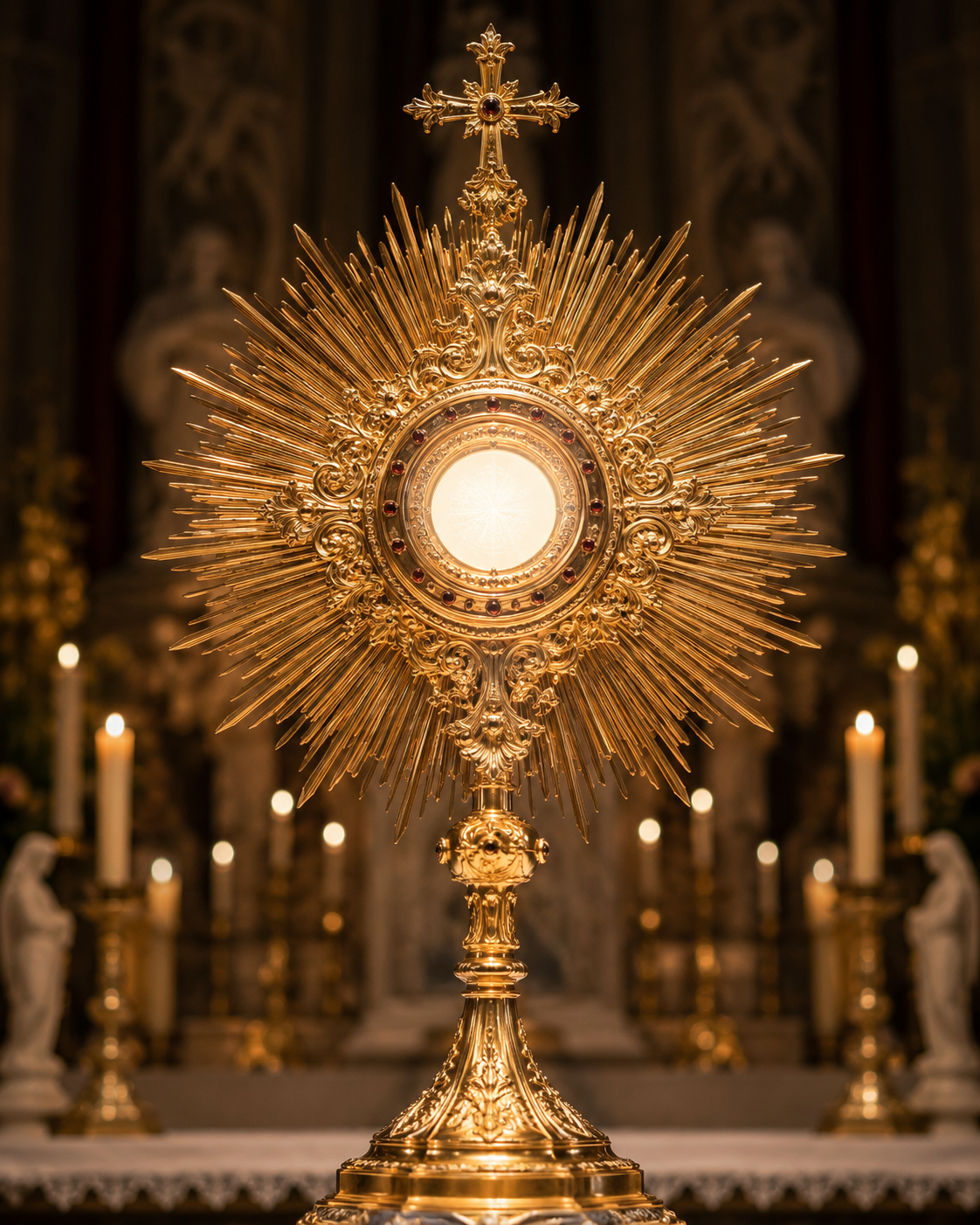
The Holy Eucharist and Spiritual Warfare
Why Satan Hates the Holy Eucharist
Why Satan Hates the Holy Eucharist
The Holy Eucharist is not merely a symbol, a reminder, or a sacred tradition. The Catholic Church teaches that the Eucharist is truly Jesus Christ Himself, Body, Blood, Soul, and Divinity. In every valid Catholic Mass, through the authority given by Christ to His priests, ordinary bread and wine become the true presence of Our Lord Jesus Christ.
Because of this reality, the Eucharist stands at the very centre of spiritual warfare.
Satan hates the Holy Eucharist because the Eucharist is Jesus Christ truly present among His people. The devil trembles before the presence of God. Throughout Scripture, demons flee before Christ, and throughout the history of the Church, saints, mystics, and exorcists have spoken of the immense spiritual power flowing from the Blessed Sacrament.
Where Jesus is adored, darkness is weakened.
This is why Eucharistic Adoration is so powerful. In adoration, souls kneel before the living God. Hearts are transformed. Sin is exposed. Vocations are strengthened. Families begin healing. Faith deepens. Many people who felt spiritually lost begin hearing the call of God again.
The enemy does not want humanity near the Eucharist because the Eucharist restores communion with God.
Scripture and the Real Presence of Jesus Christ
The Catholic belief in the Real Presence did not begin in the Middle Ages. It comes directly from Jesus Christ Himself and was believed by the earliest Christians from the very beginning.
At the Last Supper, Jesus did not say, “This represents My body.” He said:
“Take, eat; this is My body.”
Matthew 26:26
And regarding the chalice:
“Drink from it, all of you. For this is My blood of the covenant, which is poured out for many for the forgiveness of sins.”
Matthew 26:27–28
The Gospel of John speaks even more strongly. In John chapter 6, Jesus repeatedly teaches that His followers must truly eat His flesh and drink His blood:
“For My flesh is true food, and My blood is true drink.”
John 6:55
Many disciples left Him after hearing this teaching because they believed He was speaking literally. Yet Jesus did not call them back to say He only meant it symbolically.
Saint Paul also warned the early Christians:
“Whoever, therefore, eats the bread or drinks the cup of the Lord in an unworthy manner will be guilty concerning the body and blood of the Lord.”
1 Corinthians 11:27
If the Eucharist were merely symbolic, this warning would make little sense. Saint Paul recognised the Eucharist as truly holy because it truly was the Body and Blood of Christ.
The Catholic Church believes that through the words of consecration spoken by a validly ordained priest acting in the person of Christ, Jesus becomes truly present in the Eucharist. This authority was entrusted by Christ to His Apostles and passed down through apostolic succession.
At the Last Supper Jesus commanded the Apostles:
“Do this in remembrance of Me.”
Luke 22:19
The priesthood and the Eucharist were instituted together.
The Early Church Fathers and the True Presence
The earliest Christians believed in the Real Presence of Jesus in the Eucharist long before the Bible was formally compiled.
Saint Ignatius of Antioch, writing around 107 AD and taught by the Apostles themselves, warned against heretics who denied the Eucharist:
“They abstain from the Eucharist and from prayer because they do not confess that the Eucharist is the flesh of our Saviour Jesus Christ.”
Saint Justin Martyr, writing around 155 AD, explained:
“We do not receive these as common bread or common drink. But as Jesus Christ our Saviour being incarnate by God’s word took flesh and blood for our salvation, so also we have been taught that the food consecrated by the word of prayer which comes from Him is the flesh and blood of that incarnate Jesus.”
Saint Cyril of Jerusalem taught:
“Since Christ Himself has declared and said of the bread, ‘This is My Body,’ who shall dare to doubt any longer?”
The early Church did not believe in a symbolic Eucharist. The earliest Christians believed exactly what the Catholic Church still teaches today.
This continuity is one of the reasons many converts eventually find their way to the Catholic Church after studying Christian history.
Eucharistic Adoration and Spiritual Warfare
Eucharistic Adoration is one of the greatest hidden weapons given to the Church.
When the Blessed Sacrament is exposed in the monstrance, Catholics are not worshipping an object. They are worshipping Jesus Christ Himself. Adoration is an act of love, reverence, reparation, surrender, and spiritual battle.
Many saints spoke of the extraordinary grace flowing from time spent before the Blessed Sacrament.
Saint Peter Julian Eymard called the Eucharist:
“The supreme proof of the love of Jesus.”
Saint John Vianney said:
“He looks at me and I look at Him.”
Saint Padre Pio warned:
“The world could exist more easily without the sun than without the Holy Sacrifice of the Mass.”
Saint Alphonsus Liguori wrote:
“Of all devotions, that of adoring Jesus in the Blessed Sacrament is the greatest after the sacraments, the one dearest to God and the one most helpful to us.”
Saint Teresa of Calcutta centred her mission around Eucharistic Adoration because she knew that without Jesus, the Church becomes spiritually weak.
The devil seeks distraction, noise, impurity, division, pride, and despair. Eucharistic Adoration opposes all of these. In adoration there is silence, humility, repentance, healing, truth, and the direct presence of Christ.
This is why many people experience spiritual resistance when they begin attending adoration regularly. Distractions increase. Fatigue appears. Temptations intensify. Prayer may feel difficult. Yet often this is precisely because the soul is drawing closer to Christ and beginning to break chains that once held it captive.
The enemy fears souls who remain close to the Eucharist.
Why Eucharistic Adoration Strengthens Priests
The priesthood and the Eucharist cannot be separated.
At the Last Supper, Christ instituted both the Holy Eucharist and the priesthood together. Through apostolic succession, Catholic priests continue to carry the authority entrusted by Jesus Christ to His Church.
The priest stands at the altar not by his own power, but through the authority of Christ acting through His Church.
When priests spend time before the Blessed Sacrament, they are spiritually renewed at the very source of their vocation. Eucharistic Adoration strengthens priests because it draws them back to intimacy with Jesus Christ. It deepens holiness, strengthens purity, renews zeal, and protects against spiritual discouragement.
Holy priests strengthen the Church.
Many saints believed that Eucharistic Adoration was essential for the renewal of the priesthood and the protection of the Church from spiritual darkness.
Saint John Bosco saw a prophetic vision in which the Church survived violent storms only by anchoring itself to two pillars, the Holy Eucharist and the Blessed Virgin Mary.
Saint John Vianney said:
“When people wish to destroy religion, they begin by attacking the priest.”
This is one reason why Satan especially attacks priests. If the priesthood weakens, the sacraments weaken in the lives of the faithful. But where priests remain close to Jesus in the Eucharist, spiritual life within the Church becomes stronger.
Why the Eucharist Strengthens the Laity
The Eucharist was not given only for priests and religious. It was given for the salvation and sanctification of all souls.
In a world filled with anxiety, confusion, temptation, addiction, and spiritual emptiness, the Eucharist becomes spiritual nourishment for the faithful.
Many Catholics testify that regular Eucharistic Adoration changed their lives. Some rediscovered confession after years away from the Church. Others found healing from addictions, deeper peace, clarity of vocation, stronger marriages, or renewed faith after periods of darkness.
The Eucharist forms saints.
The more a soul remains close to Jesus Christ in the Blessed Sacrament, the more Christ begins transforming that soul into His likeness.
This is why Eucharistic revival has always renewed the Church throughout history.
Spiritual Authority and the Catholic Church
The Catholic Church teaches that Christ entrusted spiritual authority to His Apostles and their successors. This includes authority connected to the sacraments, preaching, governing the Church, and confronting demonic forces in Christ’s name.
The Church does recognise that all Christians can pray against evil and call upon the name of Jesus. However, solemn exorcism is reserved to priests specifically authorised by the bishop.
Many experienced Catholic exorcists have stated that demonic oppression and possession involve different levels of spiritual authority and discernment. The Church approaches these matters with caution, prayer, fasting, sacramental grace, and obedience.
The power does not come from human strength. It comes from Jesus Christ acting through His Church.
The sacraments, especially confession and the Eucharist, are considered among the greatest protections against demonic influence because they unite the soul to Christ and restore sanctifying grace.
Satan fears holiness.
He fears humility.
He fears repentance.
He fears the Blessed Virgin Mary.
But above all, he fears Jesus Christ truly present in the Holy Eucharist.
The Victory of Christ
The heart of spiritual warfare is not fear. It is victory.
Jesus Christ has already conquered sin, death, and Satan through His Cross and Resurrection.
The Eucharist is the living presence of that victory among us.
Every tabernacle throughout the world contains the King of Kings. Every monstrance lifted in adoration proclaims that Christ remains with His Church. Every Catholic church becomes sacred ground because Jesus Christ is truly present there.
In a wounded and distracted world, the Holy Eucharist remains the beating heart of the Church.
And where Jesus Christ is adored, the Church is renewed.